Tuesday, 20 April 2021

Set Relativism

I'm autistic and when I was younger this condition was much more pronounced for me. One of the main concepts that is difficult for some autistic people to grasp is the concept of other perspectives and subjectivity. When I was young I didn't consider other peoples emotions, I instead only considered my own. To me everything was an objective reality aligned with my own experiences. This made me not a very nice person and made it difficult to adapt to society and social settings, so for a long time I didn't have many friends at all. What helped me move away from this perspective wasn't just over time, but it was a logical and philosophical undertaking that is under pined by my greatest interest, Physics.

When I was about thirteen my brother taught me about something in school he had recently learned, Einstein's Theory of Special Relativity. My understanding of the universe at the time was one of objectivity, that things exist because they simply do, that science is the truth and everything else is false. Special Relativity tells us that things in the universe that we believe are constant, like the passing of time and the dimensions of space, are not necessarily so and instead depend on the velocity you're moving at. As you get closer to the speed of light things around you appear to slow down, time moves slower in your perspective. Importantly though those objects aren't moving slower, they just appear to be moving slower from your perspective because those objects appear to be moving fast and to their perspective you are moving fast and it's you who is moving slower in time. I was very interested in this concept but couldn't really understand it, how could both things move slower than each other at the same time? You can only explain it by discarding the concept of an objective truth, of an object reference of time, and instead say there are two different equally valid perspectives of the universe.

This was ground breaking for me. While I understood the concept of subjectivity, like what is the best colour and what is the best song, I had always assumed and believed that even these had an objective answer.  Everything to me was objective and I didn't see myself as a perspective in a soup of subjectivity reaching for the objective but instead I was an arbitrator of the objective, my favourite song was the best song, my favourite colour is the best colour. Here however I was given the question which object is moving slower in time? And the answer is impossible to see objectively because they're moving slower in time relative to each other, thinking in terms of the objective only leaves paradox. This to me finally opened my eyes to the idea of multiple truths existing simultaneously, this moved me to Relativism.

Relativism in philosopher circles is kinda a naughty word. Philosophy is about answering the deep and meaningful questions of metaphysics and relativism doesn't really do that. It almost seems both obviously right and obviously wrong at the same time, of course things are subjective. Moral Relativism, the concept that true morals don't exist and instead depend on the society it exists in, seems like something obvious for somethings (like differing cultures and what-not) but seem totally wrong for others (it is wrong to kill pretty much universally). Relativism, to philosophers I suppose, is uninteresting and unimagined, it's like objectivism, it's "kiddy" philosophy that will one day allow you to move to real philosophy once you intellectually matured.

Truth be told this is somewhat true. As I had understood the concept that two truths can exist simultaneously, I started playing around with this concept and extended it to more things. Eventually, as one often does, I started applying it to everything and getting the perspective that "Everything is Relative", a common phrase people come up with. This helped me immensely in my life for a time, I started seeing myself as smaller with less important opinions. I was not the arbitrator of the objective but instead simply a voice in a cloud trying to get my point across. The concept that I might be wrong even if I really thought I was right became common place and I even embraced the idea that everyone could be wrong. Eventually this gave me new insights into empathy, psychology and navigation of social settings, so to me this philosophy was truly life changing. But, I had not applied the intellectual rigor yet and when I would debate this with friends they would be quick to point out its failings. If everything is relative, then is relativity relative? Is math relative? And so forth. Over time I developed my own personal theory of Relativism I call Set Relativism that attempts to address all the criticisms of relativism. I believed, with how impactful relativism had in my life that there must be truth in it. So lets explain what Set Relativism is.

The first principle in Set Relativism is that it is founded in absurdism. This is to say that whether there exists an objective truth to the universe does not matter really because such an objective truth is unprovable. If one person were to claim that they had a proposition that was true for all the universe, there would be no way he could prove with 100% certainty that the absolute truth exists. Godel's Incompleteness Theorem is perhaps a testament to that. The theorem states that no mathematical theory can be both complete and consistent at the same time. Most of our mathematics rely on things known as Axioms, these are assumptions that we cannot prove are true but instead assert are true as part of the foundations of our mathematical formulation. Unfortunately we didn't create the physical universe we live in so we can't assert the axioms of our universe and instead can only infer them. These axioms are the laws of nature, the rules of physics we try to document, but where these rules came from we can never truly know and because the best we can do in figuring out these rules is to simply infer they exist we can never truly know whether these rules actually exist in the way we believe them too. So we can never truly prove any foundational proof of our universe, at least that's what Set Relativism postulates. As part of the relativistic theory itself, it doesn't claim to know things as that would be paradoxical. Instead Set Relativism says we assume that no objective truth is provable, and go from there, knowing in our minds that this foundation can be wrong.

The second principle in Set Relativism is that the universe is full of observers. Observers are not necessarily conscious, but are all perspectives, an infinite number, that the universe can possibly be rendered at. A perspective on a fundamental level can be seen as a sort of mathematical algorithm, a set of rules to apply to every point in the universe at every point of time. From these rules you assign certain properties to these points of spacetime in which you can ask questions, what is the colour, what is the distance, what is the morality of this point? For example, how I see this universe is a perspective based on my history, philosophy and limited human physiology, as well as my place in space-time and limited life span. I could ask "what is the colour of this text" and I can say "Black", I could also ask "what is the colour of the star 100 light years away 2 billion years in the future" and the answer would be "I don't know", as that's beyond my possible reference frame. A rock would equally have a perspective, it's function would be governed by physics and it's interpretation, it can only record interactions it has directly. Rays from the sun cause it to increase in temperature, time causes it to eventually crumble, ask it a question like is something morally good and it would have no answer, but ask it about it's physical interactions and it can answer. A question-answer dichotomy may not necessarily be the best analogy, a rock obviously can't answer questions, but what my point is, is that an observer is simply a state of possible interactions ran through some internal mathematical function. Each observer interacts with a limited number of things and these interactions interact in a specific way potentially unique to that observer. The whole collection of possible (and impossible) interactions within all time and all space for that observer make up the perspective of that observer.

The third principle is that each set of observers creates a new observer. As atoms create molecules which create proteins which create cells which create brains which create you, each component when combined creates something new. This is the fundamental concept that makes Set Relativism slightly different as it encompasses not just observers but sets of observers.  Another minor concept here is it also encompasses virtual observers, observers that exist within observers in sort the opposite fashion as a set of observers. An example of a virtual observer is the world of mathematics, it's an observer that doesn't really exist but instead exists as an idea in another observer. We'll get to why the concept of observer sets and virtual observers are important in the fourth principle.

The fourth principle is that truth only exists within the confines of an observer set. That is any truth must be framed within a set of observers. For example, normally when we talk about morals we talk with an implicit observer set of humanity, we say what are morals to humanity, not what are morals to animals or to rocks. We know rocks don't have morals, we know that question makes no sense, so we implicitly frame our question of what are good morals in terms of the limited set of humanity. We may ask what is the best song, but what we should instead frame the question as is what is the best song to this group of people, like what is the best song to our friends, to our relatives, to the world, to the universe, each will have a completely different answer. Mathematical truths may seem to violate this. Mathematical truths are true everywhere, it doesn't matter if you're a rock, a human or a god, 1 + 1 will always equal 2. But we have actually implicitly pointed mathematical truths to an observer set, the virtual observer of mathematics itself. Remember the axioms before? We created a universe, a new observer (the virtual observer) with some fundamental rules that we assert are true for this observer, then knowing those rules can prove absolute facts (like 1 + 1 = 2). But these facts only are absolutely true in the universe we created, they're still only true to the virtual observer we created, there is still an implicit concept of relativism here. We cannot prove that 1 + 1 = 2 in our universe, we can only infer that mathematical truths seem to be consistent with universal ones, but we can't prove it.

The Fifth and final principle is the concept of the unknowable. For any questions there could exist a set of observers to which that question is unknowable. An example is what is the best colour, to me the best colour is red and if the observer set is just me this becomes the truth for that observer set. However if I were to ask a friend as well and they said blue, if we combined both our perspectives and we were unable to convince each other of any answer the question of what is the best colour suddenly becomes unknowable. It's possible, but not provable (see the first principle) that all questions could be, when encompassing all perspectives, unknowable. 

What do all these principles actually give us a guiding framework? I've already typed a lot so maybe I will just summarize what I believe are the ramification of these principles in nice little words.

  1. Everything you know should be considered a belief, and there should exist some doubt in your mind for even the most trivially true assertions. Facts do not exist.
  2. When dealing with something that is unknowable for a certain set of observers you have two options, either convince the set of observers to follow one path or to limit your set of observers to believe in a truth. We all implicitly do this, we either argue for our point or admit that the point we have is not knowable and instead focus on what that means to us, or maybe to our close friends.
  3. Concepts should be treated in the frame of an intellectual marketplace (the famous "marketplace of ideas"). This might not be popular among my friends but it's important to realize that every opinion and even "fact" still relies on someone to believe it. Belief in that idea is the only thing that truly matters, and convincing people to believe in that idea (whether through intellectual debate, hard scientific evidence or logical fallacy) is the only way to propagate that idea.
  4. Uncertainty is OK. It is ok to believe something and to also admit you don't know if it is true. In this regard we ask what is this thing in the perspective of two different observer sets. I believe that homophobia is bad, that is fundamentally true in my perspective and fundamentally true in a lot of other perspectives too. However if I were to move my perspective to the grand universe I understand that the truth of this becomes a bit more unknowable. Even if I were to define a metric of bad, unless the metric was so obvious as to create a virtual observer (Bad = Homophobia, so is homophobia bad?) I still grant that I cannot truly know whether homophobia is bad. But not knowing whether homophobia is bad to the world or to the universe doesn't matter, what matters is that homophobia is definitely bad to me and my friends (an application of 2.), and so I'm willing to invest that principle in the wider observer set of humanity to hopefully align those ideas to mine, creating a new truth for the observer set of humanity.
  5. We all have a responsibility to spread the ideas we believe in, because if we do not they will die. Ideas progress via natural selection.

I believe Set Relativism is useful for understanding the nature of truth in our universe, even if it doesn't give any concrete answers. It has helped me immensely and is extremely important to me, but I am always happy to admit that I could be wrong and encourage intellectual debate. I hope this cleared up some ideas of my core philosophy on life and the universe.

Monday, 29 June 2020

Who would win? One Sun sized Earth or 1.3 million Earth sized Suns?

I recently posted a Twitter question asking people to ask crazy science questions, and I'm finally getting around to answering them. Two difference science questions come to mind, but because I'm waiting for Maplesoft to tell me I can have Maple, I am going to pick the easiest question first. The question is of course.


Who would win? One Sun sized Earth or 1.3 million Earth sized Suns?


The short answer is neither, they both die.

Why is the Sun sized Earth Dead?


First off the Sun sized Earth is dead, no question. Why? Well first we have to make the assumption that the Earth simply ADDS mass to be as large as the Sun. So how much mass is being added to the Earth? If we assume the Earth is just a sphere we know that the Earth has a radius of 6,371 kilometres with a mass of 5.972 * 1024 kg. The Sun, on the other hand, has a radius of 696,340 kilometres, more than 100x the radius of Earth. Because the mass of an object is proportional to it's volume and the volume of a sphere is proportional the cube of the radius we can calculate that the new mass of the earth is 7.798 * 1030 kg!

That's bloody heavy, on the surface of our new Earth-Sun gravity is 1.073 km/s, this is more than 40x the surface gravity on Jupiter and 4x the surface gravity of our Sun. A house cat would weigh as much as a grand piano on the surface! So that's great, because a lot of pressure and gravitational force means a lot of energy and because our Earth weighs MORE than the Sun you'd expect it would turn into a Sun right?

The problem is the Earth is made of very different things than our Sun. You see the Sun gets its energy from the fusion of hydrogen into helium and this fusion releases a tremendous amount of energy which causes the Sun to expand against the gravitational force the Sun is experiencing. The problem is Earth's core is not made of hydrogen but it's made of iron which cannot be fused to create energy. Iron is the most nuclear stable element in the universe and so changing it into something else such as via fusion (or even fission) actually costs energy instead of gives energy like in the case of hydrogen (or uranium for fission). The outer layers of the Earth have less iron and have elements such as silicon and oxygen that CAN fuse but these requires a tremendous amount of pressure to fuse and even our Earth-Sun is not massive enough to fuse it. The hydrogen found within a planet is simply too sparse to cause any kind of real fusion.

So what would our Earth-Sun become? Well it wouldn't remain a planet, it is simply beyond the size and mass to function as a rocky planet. The tremendous amount of pressure the core would experience would be far beyond what the core would maintain and so the planet would immediately begin to collapse in on itself. The collapse would be equivalent to a stellar supernova as a tremendous amount of energy is released in the violent collapse, dispersing a huge amount of mass outwards. Our Earth-Sun is not QUITE heavy enough to form into more exotic stellar objects like a black hole or neutron star, instead the core collapses to become extremely dense degenerate matter. Degenerate matter is not held up by the electromagnetic force like most matter is, instead it's held up by Quantum Mechanics via a principle called the Pauli Exclusion Principle. In a nutshell matter (specifically fermions like electrons, protons and neutrons) don't like to be in the same quantum state as each other but gravity is trying to force them into the same state by compressing them a tonne and so Pauli Exclusion fights against it in what's called degenerency pressure. The degenernecy pressure is more than the gravitational energy for our Earth-Sun so the core stops from collapsing completely into nuclear matter (IE: Into a neutron star).

Degenerency matter however is extremely dense at about 10000 kg/cm3, this is approximately two million times denser than Earth is. This means our Sun sized Earth quickly becomes much smaller with a radius of just 1776 km according to this website. That's shockingly close to the size of the moon! The surface gravity of the Earth-Sun is now an astounding 165,001 km/s! A house cat on this Earth-Sun would weigh as much as the Titanic! The Earth-Sun is now officially what is called a white dwarf, usually this is the result of a dead star but the Earth-Sun fits the bill quite nicely. The heat of all the energy from gravity and degenerency pressure causes the Earth-Sun to heat up to well above 30,000 C which causes it to shine brilliantly. The Earth-Sun is essentially dead, in that it's not gaining any energy and only losing energy for the rest of it's life, however it's losing energy due to thermal radiation outwards which is fairly inefficient for massive objects so you'd expect the Earth-Sun to shine for a few billion years, maybe much, much longer!

Why are the Earth sized Suns Dead?


There are two possible answers to this question. The first is a boring one because if we just simply take the components of a star and put them in a mass sized earth we essentially just get a big cloud of gas that behaves pretty inertly. Gravity would heat up the gas and cause the formation of what's called a gas planet (essentially a small gas giant) but there wouldn't be enough energy for fusion and so nothing interesting would happen. Pretty boring. So let's make it more interesting and instead we say what if we got the core of an actively fusing star and then suddenly teleport the core to only have the mass of the earth while the fusion was still ongoing? And what if we repeated that 1.3 million times? 

As said before the Sun produces a certain amount of energy from fusion which fights against the energy due to gravity. The sun fuses 620 million tonnes of hydrogen every second, fusion carries away 0.7% of the mass of mass into energy (the rest forming into helium). Using Einstein's famous E = mc2 equation we get that the Sun produces 5.58*1025 Joules of energy per second. That's the equivalent of one hundred million of the most powerful thermonuclear bombs going off at once, every second. 

But unfortunately we have to keep in mind the premise of the question, we're REDUCING the size of the Sun to the size of the Earth so we're gonna reduce the Sun's mass. Using the same proportion as we calculated before we know that the Sun is about 331,000 times heavier than the Earth so we're gonna reduce the energy to that proportion. So for one Sun-Earth we release about 1.683*1020 joules of energy with the fusion stopping immediately because the Sun-Earth is not massive enough to keep fusion going. This is now only 100 times more powerful than the most powerful thermonuclear bomb so it's not nearly as impressive despite the fact we're causing a tremendous amount of destruction. All in all sadly the fate of our Sun-Earth even in this scenario doesn't change much. Essentially a large chunk of gas would be blown away by the explosion but ultimately the explosion probably wouldn't be powerful enough to blow away all the gas and so the gas will eventually condense again after millions of years and form a slightly smaller gas planet. All in all it's a little lame, but we need to remember we have 1.3 million of these little bombs...

So who would win?


Well as I said before they both kinda die, but maybe the question of who would win is less about who survives and more about how spectacularly they die. So a better question is who produces the most energy? 

We'll start with our Earth sized Suns, we calculated before that one Earth sized Sun produces 1.683*1020 Joules of Energy upon it's death but we have 1.3 million of them giving a total of a massive  2.188 * 1026 joules of energy or over ONE BILLION of the most powerful thermonuclear weapons humanity has ever created all going off at once. That's a very big bomb!

But this, unfortunately, absolutely pales in comparison to the bomb we created with our Sun sized Earth. As I said before the collapse of our Sun sized Earth releases as much energy as a small supernova. To calculate the energy released we notice that the energy comes from the difference in the gravitational binding energy. The equation for gravitational binding energy is given as:
We have to calculate how much energy was released by comparing the gravitational binding energy from when the Earth-Sun was the size of the Sun to when it was the size of a white dwarf (the moon). The initial gravitational binding energy is -1.748 *1043 Joules, that's a LOT but we have deduct it from the gravitational binding energy of our white dwarf which is even more massive at -6.855 * 1045 Joules! This means the total amount energy we outputted is a massive 6.837 * 1045 Joules! That's 30 quintillion times more powerful than our 1.3 million Earth sized Suns could ever hope to achieve. How many of the most powerful thermonuclear bombs is it? It's 1,000,000,000,000,000,000,000,000,000 many thermonuclear bombs going off.

So both stars die, but the Sun sized Earth dies much more spectacularly than the 1.3 million Earth sized Suns, and now we know!

Wednesday, 29 April 2020

Is it possible to win this game?

s it possible to win this game?


The game


You have two players, a Guesser and a Tester. The Tester draws two random cards in a deck of standard playing cards (not including jokers) and looks at the cards without showing the Guesser. In order for the Guesser to win the game the Guesser must deduce with 100% certainty the suit of any one of the Testers cards. The Guesser can ask any yes or no question they like and the Tester answers each question the following way:
  1. Look at the first card, ignoring the second card, and ask the question with just the first card in mind. 
  2. Now look at the second card, ignoring the first card, and again ask the question but this time only keeping the second card in mind.
  3. Decide which answer (1 or 2) you wish to say to the Guesser such that the Guesser gets as little information as possible.
An example, suppose the Tester picked up a hearts and a clubs, if the Guesser asks "Do you have a hearts card?" The guesser would do the following:

  1. Look at just the hearts card and ask "Do I have a hearts card?". Answer is yes.
  2. Look at just the clubs card and ask "Do I have a hearts card?". Answer is no.
  3. Decide to say No (2) to give the Guesser as little information as possible.
The question is can the Guesser always win no matter what the Tester answers?


Answer


Let's find out. For the proof we'll call the suits of the cards H (hearts), C (clubs), S (spades) and D (diamonds).

Getting rid of the trivial case

First thing we notice immediately is that if the Tester picks up two cards of the same suit then the question is trivially resolved because the Guesser will be forced to answer "Yes" if the Guesser asks if they have a card of that suit. For example if the Tester picked up two hearts and the Guesser asked "Do you have two Hearts?" the Tester looks at both cards individually and both times he is forced to say yes. So for the remainder of this proof we're going to assume the Tester picks up two cards of different suit.

What questions should we be asking

The second part of this is to ask ourselves what questions we should really be asking and what questions the Tester can take advantage of. The first thing we get from the example is that asking for any one particular suit will give no information because the Tester will always be able to say no. One might be tempted to ask a question like "Do you have a hearts AND a spades?" but this question is does not make sense to the Tester and he'll always have to say no. He might look at his Hearts card and ask "Is this both a hearts and a spades?" and the answer is clearly no, it is just a hearts card, so asking whether the tester has both a hearts and a spades card will yield no results. The answer that gives information is not to ask whether the Tester has a hearts and a spades but to ask whether the Tester has a hearts OR a spades, if he has both he'll be forced to answer yes to this question. It only works with two suits though because if you asked whether he had one of three suits (Hearts, clubs and diamonds) he will always have one card in the list and so will always be able to say yes, giving no information.

So now we have some questions to answer, we can go through all six possible combinations of two suits and ask whether the Tester has one OR the other. The Tester will be forced to say Yes to the question that contains both his suits and No to the question that contains neither of his suits, but what about all the other 4 questions? For those 4 he can say whatever he wants. Lets draw up a truth table to describe the possible answers a Tester can give, in this case we will assume the Tester has a H (hearts) and a S (spades)

The truth table is really large because there's 24 different options the Tester can choose from so to narrow it down we'll cut out three obvious cases. The first two cases are obvious.

The Tester says No to every combination except the one he's forced to say Yes to:

In this case it's trivial, we simply pick any one of the two suits for the question he said yes to, he's given away the answer!

The Tester says Yes to every combination except the one he's forced to say No to:

It's simply the negation of our first example, pick any suit outside of the two suits in the combination he said no to. He's given away the answer but in a more roundabout way.

The Tester has said Yes to two combinations but has said No to every other combination:

This one may seem more difficult but it's also trivially solvable. The two combinations that he said Yes to will have to have a common suit and so whatever that common suit is, is the suit that they have. So for example if they said yes to H / C and H / S then it's clear that H is a suit that they have!

Ok so now that we've gotten the easy scenarios out of the way lets talk about the harder scenarios

The Tester has said No to two combinations but has said Yes to every other combination:

This time we can safely determine a suit that the Tester definitely does not have but we can't determine which of the three remaining suits the Tester does have. Let's draw a truth table of possible outcomes to illustrate this point:


Iteration
H / S
H / C
H / D
S / C
S / D
C / D
1
Yes
Yes
Yes
Yes
No
No
2
Yes
Yes
Yes
No
Yes
No
3
Yes
Yes
No
Yes
Yes
No
4
Yes
No
Yes
Yes
Yes
No
In iteration 1 and 3 we can see that Diamonds is the shared suit in the No's so we can definitely say they don't have a diamonds. In iteration 2 and 4 we can see that clubs is the shared suit so we know they definitely don't have a clubs. What we can now is fairly easy, look for a suit combination that is a Yes but contains our excluded suit. For example in iteration 1 we've discarded Diamonds, which means that when he said Yes to the Hearts or Diamonds question, we know that he MUST have a hearts because he CAN'T have a diamonds. For iteration 2 we see he doesn't have a clubs but we also see he said yes to whether he had a clubs OR a hearts so again, we know he has a hearts! It requires a little bit more work but it's fairly obvious when we think about it. Finally we have our final possibility.

The Tester says Yes to half the combinations and No to the other half

This is when the Guesser runs into problems


Iteration
H / S
H / C
H / D
S / C
S / D
C / D
1
Yes
Yes
Yes
No
No
No
2
Yes
Yes
No
Yes
No
No
3
Yes
No
Yes
Yes
No
No
4
Yes
Yes
No
No
Yes
No
5
Yes
No
Yes
No
Yes
No
6
Yes
No
No
Yes
Yes
No
The first thing to notice is that iteration 1 and 6 are trivial, in this case there is a common suit between all the Yes's which means we can safely pick that suit (in 1's case it is Hearts, in 6's case it is Spades). The second thing to notice is 3 and 4 are also solvable because the Yes's both share the common suits and have inconsistencies. For example in 3's case there are two yes cases that contain hearts, 2 yes cases that contain Spades and 1 yes case containing a clubs and 1 yes case containing a diamonds. We can safely say that clubs are diamonds are not the suits the Tester has, so we can easily solve this problem.

The trouble occurs in iteration 2 and iteration 5, the issue is there is no way to distinguish between each iteration. In this case all we are able to do is exclude a suit, in the case of iteration 2 we can safely confirms diamonds is definitely NOT a suit and in iteration 5 we can safely confirm clubs is NOT a suit. But in this case we have three suit contenders and there's no information about which suit is the correct one.

For iteration 2 for example we know that the Tester has a hearts, spades OR a clubs, we know that out of these three the Tester has two of them that's all we can confirm. He's only given us all Yes's for any combination containing any of these 3 suits. We've effectively moved the problem into a three suit problem and this three suit problem is unsolvable, because if you guess any two of three suits you'll always get a yes, so you can just say yes all the time.

Currently I don't believe there's a way to minimize this problem which means the final answer is:

Yes the Tester can always (granted he picks up two different suits) make it impossible for the Guesser to get it right

Wednesday, 8 April 2020

Informal Proof Printing Money Bridges Gap Between Rich and Poor.

Informal Proof Printing Money Bridges Gap Between Rich and Poor.

One of the big questions about universal basic income (UBI) is "how are you going to pay for it?". While there are many good schemes such as increased taxes that can pay for it, there's one thing a lot of people don't consider. Why don't we just print more money?

Because of inflation right? If we printed more money than the value of money goes down and so no extra value has entered the economy, right? Yes, but I'm here to prove to you that even though no value has actually entered into the economy the poor still get richer at the expense of the rich getting poorer. How does this make sense? Lets find out.

To set up our society suppose we have an economy with some amount of total money and some amount of total people n. We say we want to print some amount of money C to pay exclusively for universal income. We say that before applying universal basic income the total value of the kth person's worth is given by the function Q(k). Notice I used the word "value" here, value is described simply as the fraction of the total amount of money in the economy that person has, not the total amount of actual money that person has. This will become important when we start talking about inflation because after inflation money is worth less so talking about money in raw terms is not very useful, in UBI everyone gets more money. Instead we want to know how much value that person gets and so we have to make that distinction.

When we're printing new money we cause inflation, the value of a single dollar is worth less than it used to be. I am going to call the degree the value of a single dollar decreases our inflation factor and it's given trivially by this equation.
We also want to know how much money each money (not value) someone will get from UBI, if we assume the money is distributed equally the amount of money someone gets can be given as
This means the total value a person will have after UBI is given out is the total amount of money they have (the money they have initially + the UBI payment) multiplied by the new value of the dollar (the inflation factor). Describing this equation:
Factoring out we get
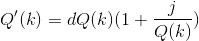
Great but we care about how their value changes not their absolute new value, we can calculate this by simply dividing their new value by their old value to give us.
So lets notice something here, d and j are both constants so the only variable on the RHS is the initial money we started with. The proportion of gain or loss we get is inversely proportional to the amount of money we initially had. The more money we had the more loss we should expect, the less money we have the less loss we should expect. This means that poor people should expect greater benefits from UBI than rich people even when factoring into account inflation, but how good are these benefits really?

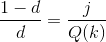
To figure this out we should ask ourselves how much money do we need to break even, ie: not gain or lose any value after UBI. If we have more than this amount of money we should expect to lose value and if we have less than this amount of money we should expect to gain value. We can figure this out by setting the LHS side to 1 and solving.


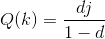
Great! But this form of the equation is a little abstract, let us expand out the inflation factor d and the UBI income per capita j to see something quite interesting...


That's right in order to break even the amount of money you need to start with is the average amount of money in the society. If you have below average income you will GAIN value and if you have above the average you will LOSE value. Therefore printing money favours the poor at the expense of the rich! Woohoo we've solved it right?

"But surely the rich could raise prices, and then make UBI useless!"

Argh those dastardly rich! But are we actually sure that the rich raising prices will disadvantage the poor? Let us investigate, to model this we should introduce a price of a good, we'll call the value of the good G so that the number of goods (A for amount) someone can buy is simply given as
Notice that G here is once again value not money. If we were to call the value of the good after UBI is implemented (and the rich raise prices) G' then the equation:
Does NOT mean the prices of the good hasn't changed, it means the VALUE of the good hasn't changed or that the price of the good increased with inflation exactly. Noting that we will introduce a factor q which is an arbitrary factor that is how much the rich increased the items value after UBI. Giving the new value of our good as:
If q is greater than one then the rich have raised prices unfairly and if q is less than one then the rich have failed to raise prices and the poor are unfairly advantaged. If q is exactly equal to one than the rich have done the right thing and have raised the prices of the good exactly proportional to the amount of inflation. The new number of items a person can buy is now equal to their new value divided by the new value of the good.
Expanding out Q'(k) gives us our final equation
We want to know whether someone can buy MORE goods or LESS goods so we divide the new amount of items someone can buy with the previous amount of items someone can buy
Doing some cancelling we get
Cool! So now we know how much more a specific person can buy but once again we want to know who is advantaged (can buy more) and who is disadvantaged (can buy less). To figure this out we once again set our LHS to 1 to find out what value you need to break even, if you are above that value you will be able to buy less and if you are below that value you will be able to buy more. Solving we get:


Great! Somethings to note here. Lets suppose prices do not change with inflation, what happens here? In this case q is exactly equal to the inflation factor d which means we get a division by 0, that seems broken but it's not it just means there is no solution to this equation which means no matter how much money you have you'll ALWAYS be able to buy more goods. This makes sense because again, everyone gets more money so if the prices don't change to reflect that then everyone's buying power increases.

Ok but what happens if the rich do the right thing and increase their prices with inflation, in this case q just becomes 1 and we get this familiar equation again:
Low and behold that's the exact same equation we got before and once again when we expand d and j we get.
That's right even if prices increase with the resulting inflation the poor still can buy more if they have less than the average income. Why? Because even if the rich get the same value for the goods that they're selling the value still initially changed to favour the poor when UBI was introduced so the poor STILL have more buying power even when you take into account a price increase.

What if the rich raised the prices even more, beyond inflation? First of all, yes this certainly COULD happen but the rich don't need UBI to do this, they can increase prices unfairly right now! The mechanisms that are stopping the rich from raising the prices of goods arbitrarily high right now will still exist even after UBI is implemented. But suppose the rich did raise prices higher than inflation, what would happen? 

Well you can plug in some random values of q, any value greater than 1 unfairly favours the rich and any value less than 1 unfairly favours the poor. But for values greater than 1 you'll notice something, there will always be an amount of money that you can have, below which, you will be able to buy more items. When q is greater than 1 the rich do get richer and the middle class gets poorer but the lowest class STILL manages to get richer, this stops becoming true when q is so high that the amount of money you need to have less of is smaller than the price of a single good. Can the rich raise prices so drastically high? Of course, but again whether they could do that isn't a question of UBI, they could raise prices this high with or without UBI and it'd have the same effect, people can buy less items.

Anyway I hope that clears up why printing money to pay for UBI can still have a beneficial effect on society.